Canada’s forests are managed responsibly, as expected by Canadians coast to coast to coast. Our forests support jobs and communities, are home to wildlife and biodiversity and must remain healthy for future generations.
Forest management certification plays an important role in meeting those expectations by ensuring harvesting is carried out in a manner that respects and maintains the full range of environmental, social, and economic values across forest landscapes, while providing independent verification that forestry practices meet high standards.
What Is Forest Management Certification?
Forest management certification is a voluntary, third-party system that allows forest companies to have their forest management plans and practices independently assessed against internationally recognized sustainability standards.
Certification provides independent verification that:
• forest use is planned with long-term forest health and regeneration in mind;
• key ecological values—such as water and wildlife habitat—are identified and respected;
• harvesting decisions consider social, cultural, and economic values alongside environmental ones; and
• workers and communities are protected through strong social and safety requirements.
Certification is a voluntary action that builds on Canada’s robust legal framework for forest management by setting additional, independently verified requirements that go above and beyond provincial and federal requirements.
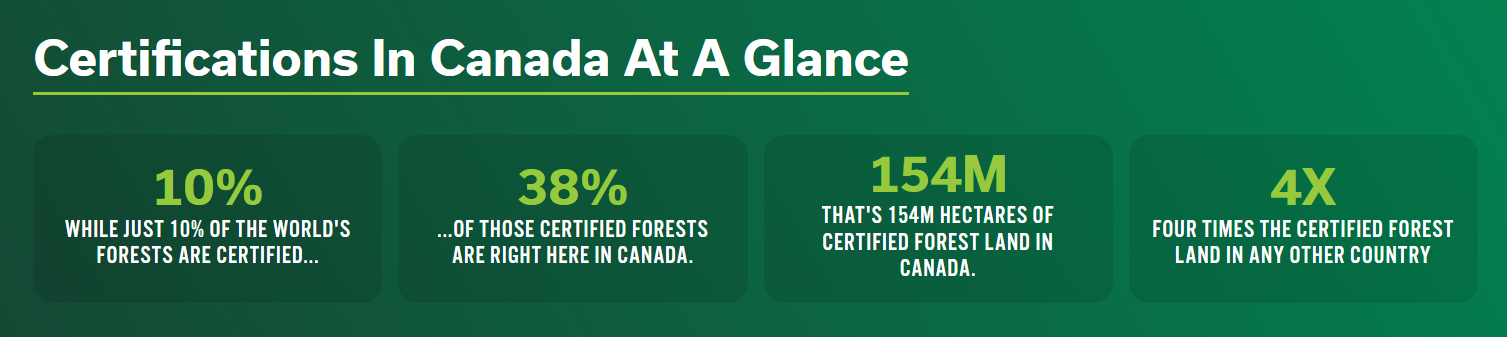
In Canada, 154 million hectares of our forest land is certified. That’s equivalent to all the land in Ontario and Manitoba combined.
In fact, Canada is a world leader in forest certification. While only about 10% of the world’s forest are certified, Canada accounts for 38% of that area—more than one‑third of all certified forests worldwide, and roughly four times more than any other country.
Why Certification Matters
Globally, deforestation and forest degradation are growing concerns for governments, buyers, and consumers. In that context, forest certification provides certainty. Whether purchasing wood, paper products, building materials, or everyday goods made from wood fibre, certification helps assure buyers that products come from forests that are managed responsibly and sustainably, and not from practices that contribute to deforestation or unacceptable forest degradation.
By reducing uncertainty along supply chains, certification allows consumers and buyers to make informed choices aligned with their environmental and social expectations. Certified forest products are widely recognized in domestic and international markets, helping Canadian producers meet the growing demand for credible, independently verified proof of sustainability.
Certification Evolves Over Time
Forest management certification is not static. As scientific knowledge advances and public expectations evolve, certification systems are regularly reviewed and updated through structured, multi‑stakeholder processes. These processes bring together forest professionals, scientists, environmental organizations, Indigenous leaders, workers, and other rights‑holders to define, test, and strengthen standards over time.
As a result, certification requirements have progressively expanded and deepened—particularly in areas such as biodiversity conservation, climate resilience, worker health and safety, and meaningful engagement with Indigenous Peoples.
Canada’s high level of forest certification reflects decades of investment in strong forest management frameworks, professional forestry expertise, independent oversight, and inclusive governance. Certification is widespread across Canada’s managed forests because it aligns with how forestry is practiced here: science based, highly regulated, participatory, and planned at a landscape scale to account for key ecological processes and values over the long term.
Making Certification Easier to Understand and Identify
The three independent certification programs used in Canada - the Forest Stewardship Council (FSC), the Program for the Endorsement of Forest Certification (PEFC) Canada and the Sustainable Forestry Initiative (SFI) – are applied voluntarily by different companies and groups, and information is often scattered across multiple sources.
To make it more transparent and accessible, FPAC has brought this information together in one place through its forest certification webpage. The data allows the public, buyers and policy makers to see where forests in Canada are certified, understand how certification is distributed across regions, and confirm whether products are sourced from independently certified forest areas—helping build transparency and confidence in how Canada’s forests are managed.
Additionally, certification does not stop at the forest. Chain‑of‑custody certification complements forest management certification by tracking wood from certified forests through the supply chain and allows verified content to be communicated on product labels. Finally, certification information will include area‑of‑origin details, allowing consumers and buyers to identify Canadian products and make informed purchasing choices.
Foundation for the Future
Canada’s forests will continue to play a critical role in supporting communities, addressing climate challenges, and supplying renewable materials for our economy. Forest management certification helps ensure that this role is carried out with accountability, transparency, and a commitment to continuous improvement.
By making certification visible consistent, and accessible, FPAC’s certification page supports informed decision‑making by the public, buyers, and policy‑makers, and reinforces Canada’s position as a global leader in sustainable forest management.