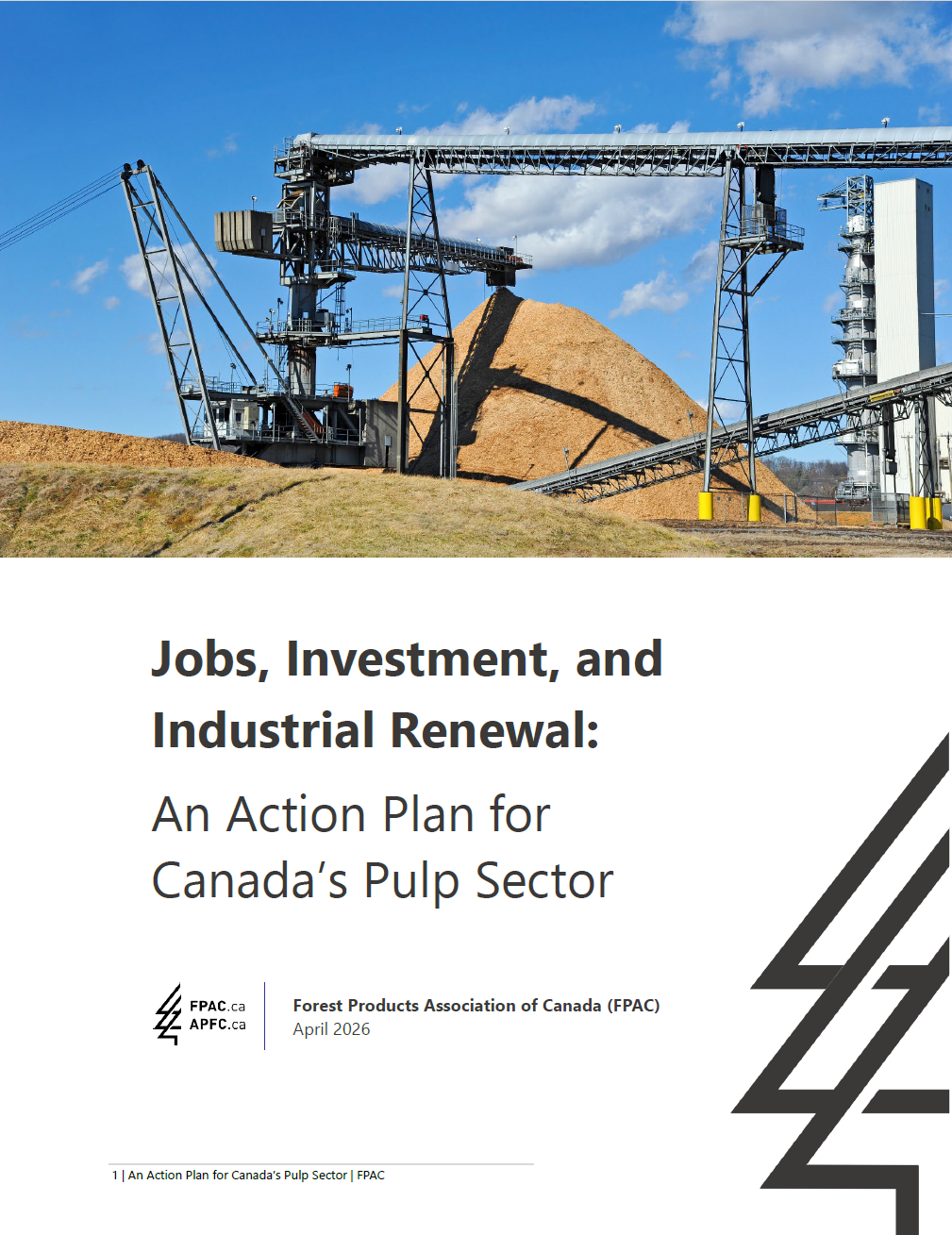


Jobs, Investment, and Industrial Renewal
An Action Plan for Canada’s Pulp Sector
Canada’s pulp sector is a cornerstone of the forest bioeconomy and a critical enabler of economic growth, climate progress, and regional stability. Sitting at the centre of a highly integrated forest value chain, pulp manufacturing transforms fibre and residues from upstream forest activities into essential products, clean energy, and recyclable materials—supporting circularity across Canada’s broader bioeconomy and anchoring employment in rural and Indigenous communities across the country. As electricity systems decarbonize and markets demand lower-carbon materials, Canada’s pulp sector is also evolving into a more modern, efficient, and innovation-driven platform for industrial renewal.
A Strategic Asset Facing a Transition Moment
Like other capital-intensive manufacturing industries, Canada’s pulp sector is navigating a period of transition. Shifting global demand, heightened international competition, trade uncertainty, and aging mill assets have constrained investment in recent years. At the same time, capacity changes elsewhere in the forest sector have reinforced the importance of strong, resilient fibre supply chains—and the need for a future-ready pulp manufacturing base that can compete on cost, carbon intensity, and reliability.
These pressures should not be seen as structural weaknesses. Rather, they point to a sector entering its next modernization cycle—one where targeted policy action can unlock productivity gains, accelerate decarbonization, improve cost competitiveness, and crowd in private capital already poised for deployment.
Unlocking Opportunity Through Targeted Federal Action
International experience shows that well-designed public policy can play a catalytic role in accelerating industrial renewal. Countries such as Finland have successfully paired public investment with private capital during periods of market disruption to modernize mills, strengthen competitiveness, and position their pulp sectors for long-term growth and innovation.
Canada has comparable advantages—and now a critical policy window to act.
This policy brief outlines three targeted federal measures that, when implemented within an efficient and harmonized federal-provincial regulatory system and alongside a reliable and cost-competitive transportation system, can reposition Canada’s pulp sector as a competitive, investable, future-ready pillar of the low-carbon economy:
1. Establish a Pulp and Paper Mill Competitiveness Program (PPMCP).
2. Make Capital Cost Allowance (CCA) improvements permanent.
3. Implement Clean Economy Investment Tax Credit (ITC) eligibility for biomass systems.
Delivering Measurable Economic and Workforce Benefits
To quantify the impact of these measures, FPAC partnered with Deloitte Canada to undertake independent economic modelling. The analysis finds that, together, these policy actions could generate $6.7 billion in real GDP and support more than 12,000 net new jobs annually between 2026 and 2030—while stabilizing operations, accelerating modernization, and strengthening long-term competitiveness across the forest value chain.
Beyond headline economic impacts, these measures would reinforce mill viability, support regional economies, and help ensure Canada remains a reliable supplier of essential forest products to domestic and global markets.
Regulatory Efficiency as a Critical Enabler
Realizing the full benefits of these policy measures depends on improving regulatory efficiency. While environmental oversight remains essential, overlapping federal and provincial requirements can introduce unnecessary cost, delay, and uncertainty—particularly for low-risk modernization projects.
A more outcomes-focused, equivalency-based regulatory approach—where provinces with robust regimes act as the primary regulator, with the federal government serving as a backstop—would reduce duplication, improve investment certainty, and accelerate project timelines without compromising environmental performance.
Positioning Canada for Long-Term Industrial Competitiveness
Canada’s pulp sector is a proven contributor to economic growth, climate solutions, and community resilience. With decisive, targeted federal action, the sector can advance its next investment cycle—modernizing mills, strengthening competitiveness, accelerating low-carbon production, and reinforcing Canada’s leadership in the forest bioeconomy.
By aligning tax policy, investment support, climate objectives, and regulatory efficiency, the federal government can help unlock private capital, support good-paying jobs, and position Canada as a globally competitive destination for pulp sector investment for decades to come—including investments that improve productivity, expand product innovation, and enable mills to be reliable suppliers of low-carbon materials and renewable energy.


.png)